


ExoMind vs. Traditional TMS: Why the Latest Generation of Brain Stimulation Changes Everything

A clear-eyed look at how ExoMind's technology, comfort, efficiency, and integrated care model represent a genuine leap forward — and what that means for people seeking relief.
Introduction
If you've ever looked into TMS — Transcranial Magnetic Stimulation — as a treatment option for depression, anxiety, or other mental health challenges, you've probably encountered the standard picture: a promising technology, meaningful results for many patients, but also a considerable investment of time, money, and comfort. Weeks of daily appointments. Loud clicking sensations. Insurance coverage that helps but doesn't fully solve the cost equation. For many people, it's a treatment they want but can't realistically access.
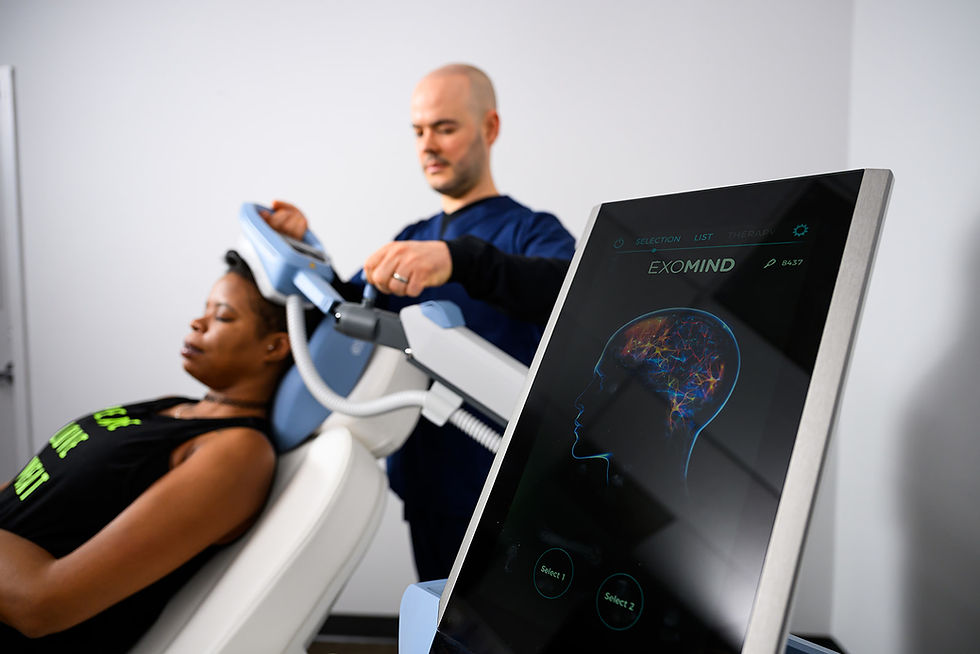
ExoMind, developed by BTL and now available at WholeMind Healing Pathways, changes that picture significantly. It's built on the same foundational science as traditional TMS — magnetic pulses directed at specific brain regions to stimulate neural activity and support neuroplasticity — but the technology, the protocol, and the care model surrounding it represent a genuine generational leap forward.
Here's what that means in practice.
—
1. THE REAL COST OF TRADITIONAL TMS — AND WHY EXOMIND CHANGES THE EQUATION
Traditional TMS protocols typically require between 36 and 40 sessions, administered daily over 8 to 10 weeks. Insurance may cover a portion of this — but coverage is far from universal, co-pays apply to each individual session, and the indirect costs of disrupting work and family life for two or more hours a day over two months are real and significant.
It's worth doing the math. Even with insurance, a $40 co-pay per session across 36 sessions adds up to $1,440 — before accounting for any uncovered portions, missed work, or transportation. For those without coverage, out-of-pocket costs for traditional TMS can reach several thousand dollars. And for many people already managing the financial weight of ongoing therapy (at $40–$50 per session, weekly therapy alone adds up quickly), the cumulative cost of mental health care is one of the primary barriers to getting the support they need.
ExoMind's standard protocol is 6 sessions — a fraction of traditional TMS requirements — each lasting under 30 minutes. While ExoMind is currently a cash-pay service at WholeMind, the dramatically reduced session count means the total investment is far more accessible than it might initially appear. We invite you to contact us directly for current pricing and to discuss which package is right for your goals.
For many people, ExoMind is not just a better treatment. It's the treatment they can actually complete.
—
2. COMFORT THAT MAKES A REAL DIFFERENCE
One of the most common descriptions of traditional TMS is the sensation of a woodpecker tapping against your skull — loudly, repetitively, for up to an hour at a time. Headaches following sessions are common. The auditory environment is clinical and often jarring. For a therapy designed to support mental wellness, the experience itself can be difficult to endure.
ExoMind's patented ExoTMS™ technology takes a fundamentally different approach. Rather than the sharp, sudden pulses of conventional devices, ExoMind uses a trapezoid waveform pattern that delivers energy gradually — dramatically reducing the snap and percussion that makes traditional TMS uncomfortable. A continuous airflow system prevents the device from overheating, which further allows for a gentler, more consistent treatment experience.
Clients consistently describe ExoMind sessions as quiet, pleasant, and even relaxing. There is no anesthesia required, no downtime afterward, and most people return directly to their normal activities — including work — immediately following a session.
This matters for more than just comfort. A treatment people can look forward to — or at least approach without dread — is a treatment people actually complete. Adherence is one of the most important factors in therapeutic outcomes, and ExoMind's comfort profile supports it directly.
—
3. MORE POWERFUL WHERE IT COUNTS — PATENTED TECHNOLOGY THAT WORKS SMARTER

ExoMind's advantages aren't only about comfort and convenience. At the core of the ExoTMS™ system is a patented coil design that maintains maximum magnetic field efficiency with minimal energy loss — delivering more precise, consistent stimulation exactly where it is intended.
Traditional TMS devices use a figure-8 coil design that has remained largely unchanged since the technology's FDA clearance in 2008. ExoMind represents the first major redesign of TMS technology in more than a decade. The result is a device that delivers stronger, more targeted stimulation to the dorsolateral prefrontal cortex — the executive center of the brain responsible for mood regulation, emotional control, and cognitive function — while requiring significantly fewer sessions to achieve comparable or superior results.
In other words: it does more with less. More focused energy, fewer treatments, better tolerability.
—
4. BROADER APPLICATIONS THAN TRADITIONAL TMS
Traditional TMS gained FDA clearance primarily for treatment-resistant depression — patients who had not responded adequately to antidepressant medications. It has remained largely associated with that narrow clinical profile.
ExoMind's FDA clearance covers Major Depressive Disorder, and clinical applications and ongoing research support its use for anxiety, OCD, binge eating disorder, brain fog, cognitive clarity, emotional regulation, and impulse control. For people who don't fit neatly into a treatment-resistant depression diagnosis but who are experiencing real, meaningful suffering — or who are simply interested in optimizing their mental wellness and executive function — ExoMind opens a door that traditional TMS largely kept closed.
At WholeMind, this broader application is particularly meaningful. Our clients span a wide range of experiences and goals — from those managing clinical depression to those seeking deeper clarity, resilience, and emotional regulation as part of an active healing journey. ExoMind speaks to all of them.
—
5. THE WHOLEMIND DIFFERENCE: INTEGRATION THAT TRADITIONAL TMS SIMPLY DOESN'T OFFER
Perhaps the most significant distinction between ExoMind at WholeMind and TMS anywhere else is what surrounds the treatment itself.
Traditional TMS is typically administered in a clinical setting with minimal supportive context. You come in, receive your session, and leave. The neuroplasticity window opened by the treatment — that period of heightened neural receptivity that immediately follows stimulation — is largely left unaddressed.
At WholeMind, we've built a comprehensive integration program around ExoMind specifically because we know that what happens in the neuroplasticity window matters enormously.
Our ExoMind program includes:
Pre-session preparation to orient the brain and nervous system toward the work ahead
Guided integration support between sessions, while the neuroplasticity window is open
Evidence-based top-down practices — including meditation, journaling, breathwork, cognitive reframing, and gratitude practice — provided as structured resources to support the brain's rewiring between sessions and invite self-discovery and insights
Ongoing support from our clinical team throughout your treatment series
This is not standard practice in TMS care. It is the WholeMind model applied to a new modality.
—
A SIDE-BY-SIDE SUMMARY
Sessions required:
Traditional TMS — 36 to 40 sessions over 8 to 10 weeks.
ExoMind — 6 sessions over approximately 3 weeks.
Session length:
Traditional TMS — up to 60 minutes.
ExoMind — under 30 minutes.
Comfort:
Traditional TMS — loud, percussive, frequent headaches reported.
ExoMind — quiet, gradual waveform, described as relaxing and pleasant.
Technology:
Traditional TMS — figure-8 coil design, largely unchanged since 2008.
ExoMind — patented ExoTMS™ coil, first major redesign in over a decade.
Applications:
Traditional TMS — primarily treatment-resistant depression.
ExoMind — depression, anxiety, OCD, cognitive wellness, emotional regulation, and more.
Integration & Support:
Traditional TMS — typically none.
ExoMind at WholeMind — comprehensive pre- and post-session integration program.
TMS has helped a great many people over the years, and its foundational science remains sound. ExoMind doesn't replace that legacy — it builds on it, refines it, and makes it available to more people in a more humane, more effective, and more accessible way.
We are proud to bring ExoMind to Prescott.
—
Ready to learn more about ExoMind at WholeMind?
We'd love to walk you through the program, answer your questions, and give you a personal tour of our clinic. Reach out anytime — consultations are always free.
📍 WholeMind Healing Pathways — Prescott, AZ
📞 (928) 550-6705



Comments